What does social fitness look like?
Social fitness is the state of having the quality and quantity of relationships required to meet our relational needs.
This principle applies whether we are an individual, a team or an organisation. At The Social Gym we use evidence-based diagnostic tools that help you to work out what your particular needs are, to assess how they are currently being met, and to identify the best next steps.
Fields of connection
We all have multiple relationship ‘fields’: these are like concentric circles ranging from those closest to us out to our broadest sense of belonging in society. At the centre of them all is our relationship with ourselves.
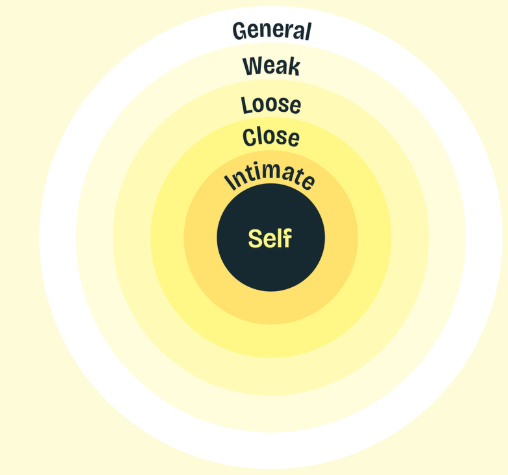
Each field serves a different purpose and requires different skills. Close friendships, wonderful as they are, cannot substitute for a sense of community. The way we relate to family is different from how we interact with the people we meet at a networking event, or to a stranger we sit next to on the bus.
The same pattern applies at every scale - so a team has its own version of concentric circles: leaders at the centre, immediate colleagues around them, the wider organisation, external partners, and the customers and communities it ultimately serves.
Social fitness — for an individual, a team, or an organisation — means having functional, well-tended relationships within the fields that matter. Most of us are stronger in some fields than others. The same is true of teams and organisations.


How we look at social fitness
When we assess social fitness - yours, your team’s, or your organisation’s - we use six lenses. Taken together, they show where you’re strong, where you’re stretched, and where to focus.
STRUCTURE - Who’s there?
The people in your life, and the networks you can reach. For an organisation: the connections between teams, departments and beyond - who knows whom, and how often they speak.
SATISFACTION - How does it feel?
How well your current relationships are meeting your needs. For an organisation: how connected people feel - to each other, to their role, to where the organisation is going.
BEHAVIOUR - What do you (actually) do?
The patterns that shape your relationships day to day - the calls you return, the conversations you initiate, the disagreements you avoid or address. For an organisation: the rituals, routines, and unspoken rules of how people work together.
CAPACITY - How skilled?
The specific skills you bring to navigating your relationships. For an organisation: the individual and collective skill of its people - like how well they listen, ask, manage conflict and collaborate.
GAPS - What’s missing?
The fields where relationships are, or feel, absent or thin. For an organisation: the connections that should be there but aren’t.
ASPIRATION - Where are you going?
The relationships you want - or will need - next. For an organisation: the connections needed to grow, change, and deliver whatever is next.
The muscles of social fitness
Relationship skills can’t be learnt from a book, a podcast or a YouTube video. They’re built through real-time practice on real issues, with guidance and support.
Like physical muscles, they benefit from consistent workouts that become incrementally more challenging.
We organise the skills into four integrated muscle groups.

CORE WORK
Foundational skills that are critical to all relationships

STRENGTH TRAINING
Skills that build endurance and define the shape of relationships

CARDIO
Skills that are crucial for the higher stakes, heart-pumping moments that feature in all significant relationships.
COORDINATION
The skills particular to groups and group life.
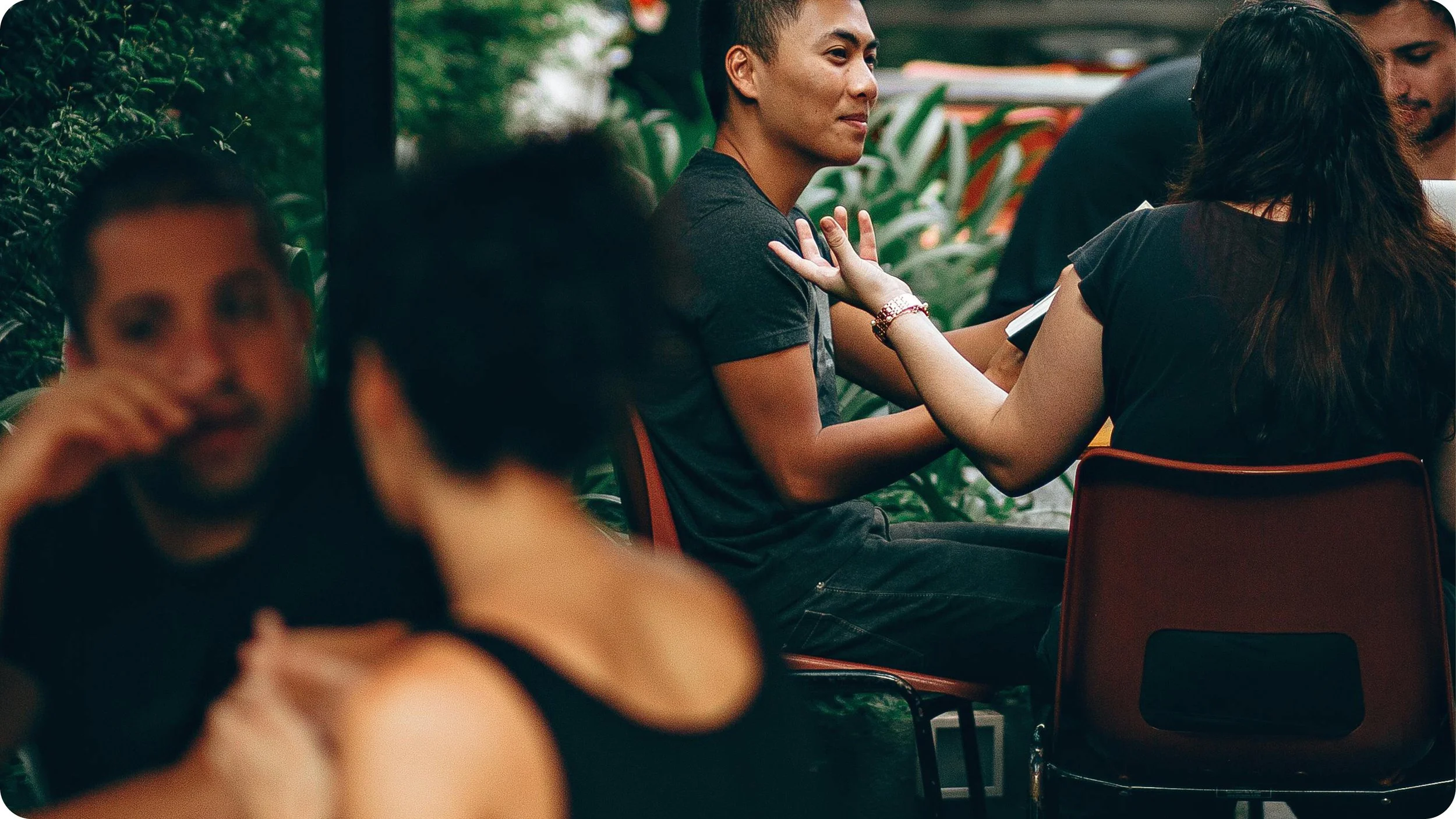

Powerful socio-economic forces are shaping our relationships - like who is made to feel like they belong or welcome in a community, the kinds of interactions we see modelled in leaders and public figures, and the accelerating impact of digital and AI-mediated exchanges.
Much of this is beyond our individual control. But there is a lot that can be done - by ourselves and within the relationship circles we shape - to ensure these forces do not dictate our social wellbeing. That’s the work of social fitness training.